Software used to be expensive. That was the whole business model.
Hard to build.
Hard to copy.
Hard to catch up with.
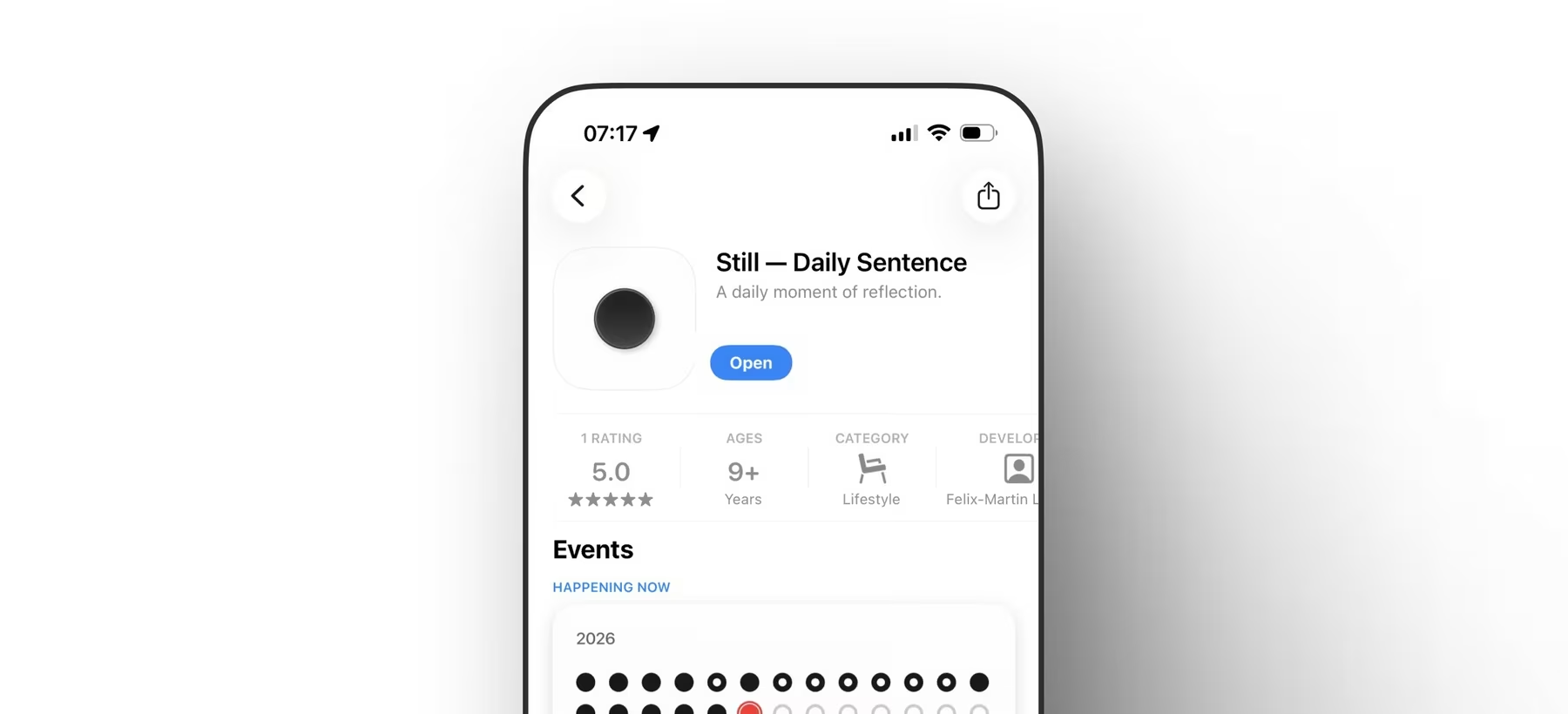
That is over. Not slowly, and not in some future quarter. A competent person with the right tools now ships in two weeks what used to take a team a quarter. I know because I did it: an iOS app, live on the App Store, in fourteen days. Not a prototype. A reviewed, shipping product.
So if the building is no longer the hard part, what is?
Most of what we called craft was labor
This is the uncomfortable part, so let me be direct about it.
A lot of what our industry sold as craft was labor. Redlining specs. Producing the fourteenth variant of a card component. Maintaining a library nobody outside the team ever noticed. Turning a decision that took ten minutes into three days of documentation.
That work was real, and it was necessary, and it is being automated right now. Defending it is a losing position.
What is not being automated is knowing what deserves to exist in the first place. That judgment does not come from the tool. It comes from having sat with real users, in a regulated product, where a wrong decision costs someone actual money.
Where most designers stop
Flows. Screens. Specs.
The ticket says redesign the onboarding, so the onboarding gets redesigned. It looks better than before. It ships. Everyone moves on.
And nothing changes, because the problem was never the onboarding.
The work that matters starts earlier and ends later. Earlier means asking whether the offer itself makes sense, whether the price is right, whether this is even the person we should be talking to. Later means staying with it after launch: reading the drop-offs, forming a hypothesis, changing one thing, checking whether it moved.
Most designers are not invited into that. Fair enough. But many are not asking either.
And then the surface disappears
There is a second shift running underneath the first one, and my friend Felix Haas wrote the clearest version of it I have read.
His argument: more and more people will reach a product through an agent. They ask, the agent does it, and the app underneath is never seen. At that point the product stops having a human user. It becomes a back end with a machine in front of it.
If that is right, and I think it mostly is, the surface where our craft used to live is the first thing to go. Not the work. The surface.
Which is a strange thing to sit with. We spent a decade making interfaces people love, and the endgame is that the best ones are the ones nobody looks at.
“In a world of invisible interfaces, brand is what remains visible.”Felix Haas, Design + AI
That sentence is the bridge to everything I just wrote. Take the screens away and the moat cannot be the screens.
What actually compounds
When the software is free, the moat moves somewhere else. In my experience it sits in three places, and they are not separable.
A product that delivers. Not feature parity. The thing the customer came for, done well enough that they do not have to think about it.
Communication that lands. The best product in a category loses to the one people understand. Positioning, the words on the page, the first ten seconds. Designers who treat this as marketing's problem give away half their leverage.
An experience worth returning to. Everything after the conversion. This is where most companies quietly stop caring, and it is exactly where trust is either earned or lost.
One thing belongs on that list that I would not have put there a year ago, and it is Haas's point rather than mine. Being reachable. If an agent cannot read your product, compare it, book it, complete it, you are not in the consideration set at all. Distribution used to be a channel question. It is becoming a structural one, and it lands on the design team's desk, because it is still interface work. Just not aimed at a person.
Do all four and growth stops being a channel problem. That is what I mean by trust by design. Not a slogan. A sequence.
What this looks like in practice
At Getsafe I run brand, app and growth as one system. The design team went from nine people to an AI-native setup, and we ship faster now than we did with nine.
That sentence sounds like a headcount story. It is not. The point is what became possible once production stopped being the bottleneck:
- Research synthesis across nine sources in an afternoon instead of a fortnight
- A rebrand delivered in six months, in parallel with the roadmap, without an agency
- Weekly changes to a live funnel, with the numbers checked before the next one
None of that is possible if your job is producing screens. All of it is possible if your job is being responsible for whether the thing works.
The uncomfortable conclusion
If your value is that you can make it, you have a problem. The tools make it now, and they are getting better every month.
If your value is that you know what is worth making, understand the person on the other side, and can tell the story well enough that something complex becomes obvious, then this is the best moment our profession has had in twenty years.
And there is a part of the invisible interface argument I want to push one step further, because it is the part I have actually lived. Once an agent acts on someone's behalf, the interesting question is not what the happy path looks like. It is what happens when the agent is wrong. Who confirms. What is shown before money moves. How a mistake gets undone, and how fast.
Those moments are the last pixels anyone sees, which means they carry the entire relationship. That is not a new problem for me. In insurance it has been the whole job for years, long before there was an agent in the middle. Fewer surfaces do not make trust easier. They make every remaining one load-bearing.
The bar moved.
It did not disappear.
It moved from making things to being answerable for them. That is a harder job. It is also a much better one.